Frequently asked questions
Appointments, insurance, costs and the most common questions about liver transplant, GI cancer surgery and robotic surgery in Noida.
Appointments, locations and insurance
Who is the best gastro surgeon in Noida?
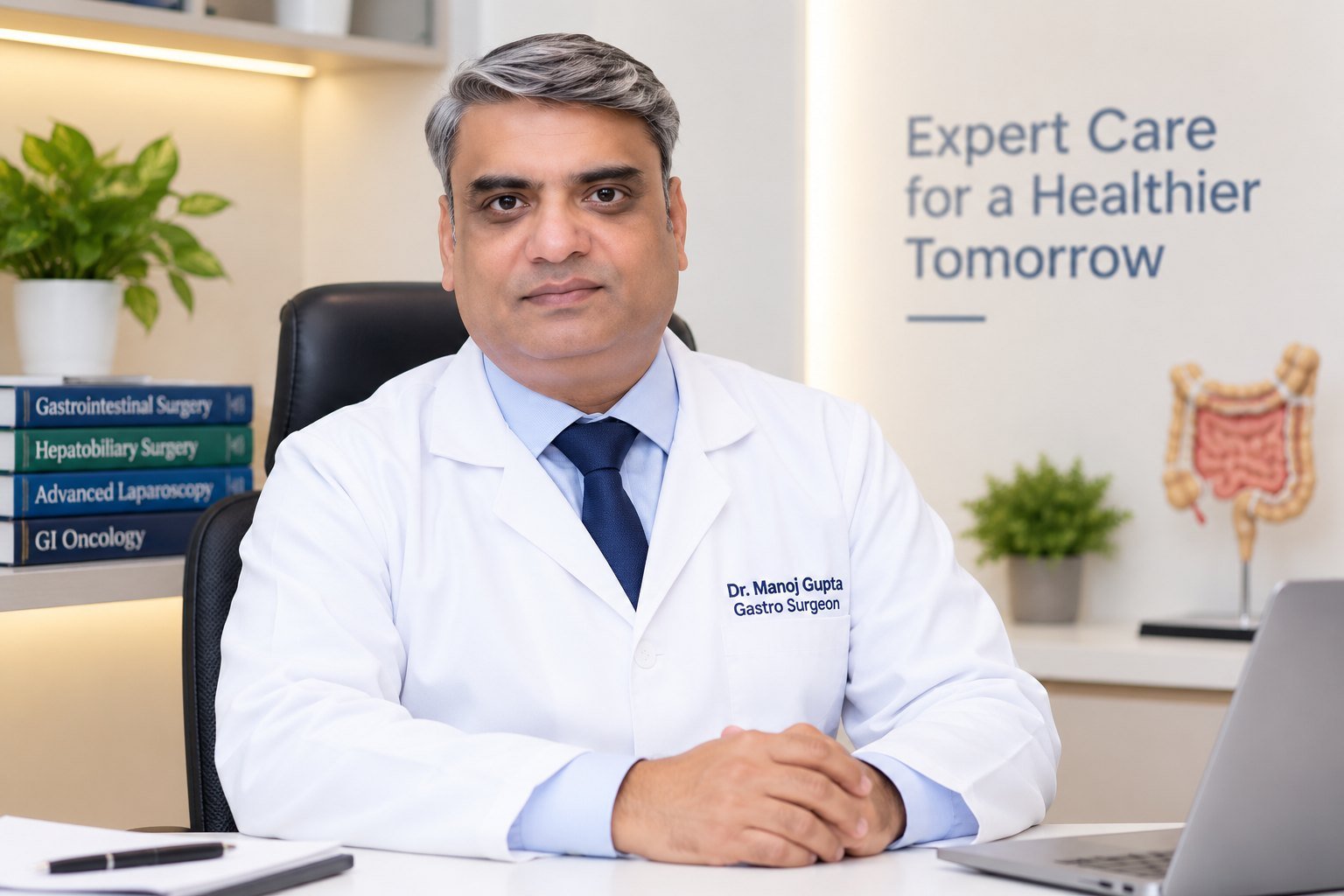
Dr Manoj Gupta is a Senior Director and Head of Robotic & Laparoscopic GI Surgery, GI Oncology and Liver Transplant at Yatharth Super Speciality Hospital, with over 20 years of experience, 500+ liver transplants and a 4.8 Google rating from 350+ patients. He consults at the hospital in Greater Noida and at his Indirapuram clinic in the evening.
How do I book an appointment with Dr Manoj Gupta?
Call or WhatsApp +91 98180 40155. Hospital OPD at Yatharth Super Speciality Hospital, Greater Noida runs Mon–Sat 10 AM–4 PM; the evening clinic at Amrapali Green Market, Indirapuram runs Mon–Sat 6–8:30 PM.
What is the difference between a gastroenterologist and a gastro surgeon?
A gastroenterologist treats digestive disease with medicines and endoscopy. A gastro (GI) surgeon like Dr Gupta performs operations — liver transplant, liver, pancreas and GI cancer surgery, gallbladder, hernia — when medicine is not enough.
Does Dr Manoj Gupta accept health insurance?
Yes. Yatharth Hospital is empanelled with most major insurers, TPAs, CGHS, ECHS and corporate schemes for cashless treatment. Bring your policy details to the first visit.
Which areas do patients come from?
Noida, Greater Noida, Ghaziabad, Indirapuram, East Delhi and Faridabad across Delhi NCR; Meerut, Muzaffarnagar, Bulandshahr, Hapur and Roorkee in Western UP and Uttarakhand; and international patients from Central Asia, Africa and the Middle East for liver transplant and cancer surgery.
Do you treat international patients?
Yes. Patients from Uzbekistan, Somalia and other countries have travelled to Dr Gupta for liver transplant, liver tumour and GI cancer surgery. Send reports on WhatsApp for an opinion and estimate before you travel; the hospital's international desk assists with medical visa letters, airport pickup and accommodation.
Do you offer second opinions on liver, pancreas or cancer surgery?
Yes. Bring your reports and scans to the evening clinic in Indirapuram or the hospital OPD. Dr Gupta reviews the imaging himself and tells you clearly whether surgery can help.
Liver transplant
How many liver transplants has Dr Manoj Gupta done?
Dr Gupta has been part of more than 500 liver transplants over 20 years, including living donor, deceased donor, paediatric and re-transplants, at Apollo, Sir Ganga Ram, Jaypee, PSRI and now Yatharth Super Speciality Hospital.
What is the success rate of liver transplant in India?
At experienced centres, one-year survival after elective living donor liver transplant is around 90%, and long-term survival is 70–80% at five years. Outcomes depend on how sick the patient is at the time of transplant — earlier referral gives better results.
Who can donate a liver?
A healthy near relative aged 18–55 with a compatible blood group, a BMI under about 30, no diabetes or major illness, and a liver of suitable size and anatomy on CT and MRI.
How long does the whole process take?
From first consultation to surgery, typically 3–4 weeks for a living donor transplant when the donor is fit. Emergencies (acute liver failure) are fast-tracked within days.
About specific conditions
Who can be a liver donor?
A healthy relative aged 18–55 with a compatible blood group, no major illness and adequate liver volume on CT. Donors are protected by law and ethics-committee review, and the donor liver regrows to full size in 6–8 weeks.
Is every liver tumour cancer?
No. Hemangiomas and FNH are common benign lesions that usually need only observation. A triple-phase CT or MRI and, rarely, a biopsy settle the diagnosis.
What is the Whipple procedure?
It removes the head of the pancreas, duodenum, bile duct and gallbladder, then reconnects the digestive system. It is the only curative operation for cancers in this region.
Can gallbladder cancer be cured?
Yes, when it is confined to the gallbladder wall or nearby liver and is removed completely with clear margins and lymph nodes. Early-stage disease has good long-term survival; outcomes fall sharply if the operation is incomplete or delayed.
Is esophageal cancer curable?
Early tumours and many locally advanced tumours are curable with combined chemoradiotherapy and complete surgery. The chance of cure depends mainly on the stage at diagnosis — do not wait if swallowing is getting harder.
Is stomach cancer curable?
Early and locally advanced stomach cancer is curable with complete surgery and chemotherapy. Outcomes are best when treatment starts soon after diagnosis.
Will I need a permanent colostomy bag?
For most colon and upper rectal cancers, no. Even for low rectal cancers, robotic sphincter-saving surgery avoids a permanent bag in the majority of patients.
ERCP or surgery for bile duct stones?
Small stones with a normal duct are often removed by ERCP, followed by gallbladder surgery. Large or multiple stones, or a failed ERCP, are cleared surgically in one operation.
Who should consider surgery for acid reflux?
Patients with proven GERD who need daily PPIs, have a hiatus hernia, or whose symptoms return whenever medicine stops. Surgery is not for occasional heartburn.
Is gallbladder stone surgery necessary, or can medicine dissolve stones?
Tablets rarely dissolve gallstones and they return once stopped. If your stones are causing pain, infection, pancreatitis or jaundice, surgery is the recommended cure. Silent stones found by chance may only need observation — Dr Gupta will tell you honestly which group you are in.
Can a hernia be cured without surgery?
No. Belts and exercises may ease discomfort but the defect remains. Surgery with mesh is the only cure and is best done before the hernia enlarges or becomes stuck.
Can appendicitis be treated with antibiotics alone?
In selected early cases antibiotics can settle the attack, but it recurs in a large share of patients. Surgery remains the definitive treatment and avoids the risk of rupture.
Do all piles need surgery?
No. Most early piles settle with high-fibre diet, fluids and medicines. Surgery is advised only for persistent bleeding, prolapse or large piles.

Still have a question?
Send it on WhatsApp with your reports. The team replies within working hours and books you into the hospital OPD or the Indirapuram evening clinic.
WhatsApp +91 98180 40155What patients say on Google
Not sure if you need surgery? Ask first.
Bring your reports for a clear, honest opinion. Same-day and evening appointments available.